


WHAT THIS COSTS
In the state with the highest uninsured rate in the country, cost isn’t a back-office question. Brands that make pricing legible convert patients that brands hiding behind “we accept most insurance” lose.



Positioning built around how Austin patients actually choose: price transparency, access and speed to appointment, alongside clinical credibility.
Names that survive Texas Medical Board scrutiny and don’t box you into a single service line as you grow. Austin practices scale fast; names that describe one procedure age badly.
Identity systems that read as clinical rather than wellness-adjacent, or deliberately the opposite — a distinction that matters more in this market than most.
Claims architecture that says something specific while staying inside what TMB rules permit.
Signage, print, intake materials and environmental design, applied consistently across multi-site practices.
For practices that have outgrown a name, merged, or added service lines the current brand can’t stretch to cover.
"*" indicates required fields













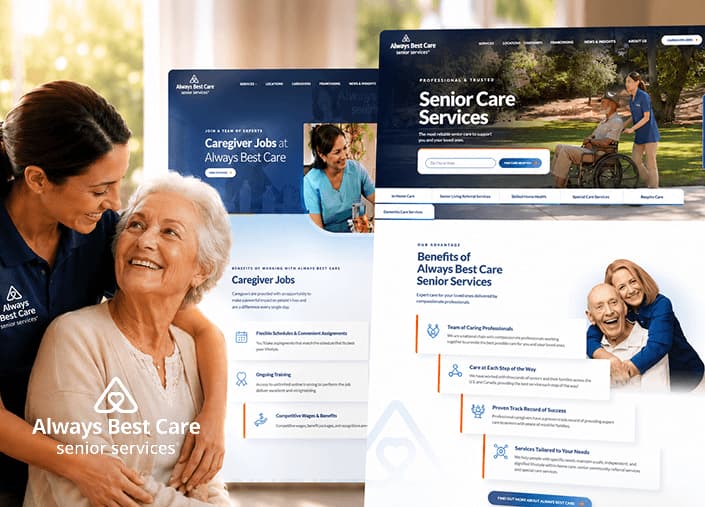
ABC Senior Services offers in-home care and senior support, though its old site read as dated and cluttered, at odds with the professional image the brand wanted to project.
Our experts restructured the content and gave it a modern, responsive design, then built domain authority through targeted SEO and backlinks.
The brand now presents as polished and credible, the reassurance families look for clear from the first visit.




In this first step, we arrange a discovery call and ask a wide range of brand questions to understand your objectives, needs, desired position and value proposition as an Austin healthcare provider.
We also review your messaging against Texas Medical Board Chapter 104 and 164 advertising rules early, so the brand platform gets built inside those constraints from the start rather than edited back into them later.
Following the discovery call, we conduct extensive market research to understand trends, best practices and patient behavior across the Austin healthcare market.
As a dedicated healthcare branding team, we analyze gaps and opportunities within that research to identify your unique brand positioning and where you stand apart from other local providers.
In this stage, our designers work diligently to produce a comprehensive brand book and style guidelines, giving you a clear roadmap for the brand you’re building.
This roadmap covers everything from tone of voice to visual application, so you can maintain consistency across every touchpoint as your practice grows and expands into new channels.
Finally, our experienced designers create a full identity for your brand, from logo to color palette, typography and other key visual elements.
Every element is built to represent your healthcare practice accurately, giving patients a consistent, trustworthy impression whether they find you online, in print or in person.

Two things. Texas has the highest uninsured rate in the country, so a larger share of patients are paying directly and choosing on cost and access as much as on clinical reputation.
And Austin’s growth means many patients are choosing a provider for the first time, with no existing relationship and no local referral network. Both push a brand toward clarity and recall rather than heritage and familiarity.
Texas Medical Board rules restrict “board certified” to certifications from qualifying bodies, prohibit “board eligible” and “board qualified” as misleading, and require objective support for superlative claims.
We review the message platform against these during strategy, so positioning lines don’t have to be rewritten after they’re in market.
It depends on what you actually deliver and who pays for it, and it’s one of the highest-stakes decisions in this market. Austin has a large integrative and concierge segment where wellness positioning works, and a large conventional segment where it undermines credibility.
We resolve it in strategy rather than letting the visual identity decide it by accident.
Early, and it matters more here than in most markets. A name that needs explaining is a cost you pay on every patient who’s new to Austin — which is a lot of them. It also needs to survive TMB scrutiny and stretch to cover service lines you haven’t added yet.
The brand has to work as a system rather than a single expression — consistent across signage, print, intake materials and environments, with enough flexibility for locations that serve different patient populations. Austin practices tend to add sites faster than their brand systems were designed for.
We work with Austin healthcare brands remotely, with our team based in the US. Brand strategy is research-led work — market analysis, competitive review, patient research and stakeholder interviews — and none of it depends on being down the road.

"*" indicates required fields