



Brand Book Design: Key Highlights
-
Guidelines only matter when enforced: Most companies document the key guidelines, but weak adoption is why many brands still sound and look interchangeable.
-
Audience definition improves relevance: Messaging performs better when it reflects real buying context, motivations and objections.
-
Visual systems drive instant recognition: Color, typography, imagery and layout work together to signal the brand before words are read.
Why is it that you can spot Apple, Nike or Netflix in seconds, while so many other brands blur together after a single interaction?
Their visibility today comes from years of consistent signals across visual identity, messaging and product experience, until recognition becomes automatic and immediate.
95% of companies have brand guidelines documented somewhere, yet only about 25% actually enforce them, which is why so many brands end up sounding interchangeable or easily forgettable.
In this post, we’ll break down 9 tips for creating a brand book design and share examples from companies that put their guidelines to work across design, messaging and customer touchpoints.
9 Tips For Designing A Brand Book
A brand book is a document that outlines the guidelines for how a company presents itself to the public.
It serves as a comprehensive resource for all of the visual and verbal elements that make up a company’s brand identity, including its name, logo, slogan, color palette, typography and tone of voice.
By following these steps, you can create a detailed brand book design that helps you establish a strong and recognizable identity and drive business success:
1. Write A Brand Overview
The overview section is your starting point, as it provides a high-level summary of your mission, values and unique selling proposition (USP).
This helps set the foundation for the rest of the brand book, ensuring that all subsequent sections are aligned with your company’s core identity.
The brand’s USP is the key benefit that it offers to customers that sets it apart from competitors. It should be clear, compelling and easy to understand.
When Using This Strategy Works
Brands with expanding product lines, growing visibility or multiple partners benefit most from a clear overview that anchors everything that follows.
One great example of a memorable USP comes from Saddleback Leather, a company that guarantees its product longevity with the slogan “They’ll Fight Over It When You’re Dead.”

This sentence effectively communicates the distinctive quality of Saddleback’s products to potential customers, using the company’s recognizable humorous style: their products are so well-made that they will outlast their owners.
What Could Go Wrong
The overview loses value when it relies on vague statements or company-specific jargon that offers no guidance for how the brand should sound or look.
Implications For Your Brand Book Design
A well-written overview creates alignment early, but it also narrows what qualifies as on-brand.
Keep it brief enough to reference often, revisit it after changes in positioning or audience and support it with a few practical examples so people can apply it in copy, design and sales materials.
2. Build A Brand Personality
This is the set of characteristics that represent your brand and make it distinct, which helps you highlight the values that your competitors or other brands might not have.
When most people wouldn’t care if 78% of brands disappeared tomorrow, personality becomes the difference between being remembered and being replaceable.
When Using This Strategy Works
This fits brands that offer similar products or services to others in their industry and need a clear way to be described without relying on features or pricing.
For example, Duolingo’s personality is playful, direct and unmistakably informal, which helps a language-learning app feel approachable rather than academic.
That tone carries through its copy, product prompts and social content, making the brand instantly recognizable even outside the context of language learning.
What Could Go Wrong
It falls apart when the personality exists only as documentation or when it’s described in broad traits that don’t translate into copy, product language or customer interactions.
Implications For Your Brand Book Design
Your brand personality should reflect your brand’s mission, values and target audience, but it also sets boundaries that not every stakeholder will agree with.
Think about how you want your brand to be perceived, as well as whether and how your company culture supports this.
3. Identify Brand Voice & Tone
Your brand voice is your company’s distinct way of using language, including the words you choose, the phrases you repeat and the point of view you take.
With 87% of executives prioritizing brand-building, voice and tone are often the first place customers notice whether the brand is being managed well or left to chance.
When Using This Strategy Works
Define voice and tone when customers encounter the brand across multiple channels and the language feels interchangeable with others in the category.
For instance, Ryanair’s voice is blunt, irreverent and intentionally provocative, reinforcing its position as a no-frills airline that makes cost transparency a part of its identity.
That consistency in tone turns customer interactions and social content into extensions of the brand promise rather than isolated marketing campagins.
What Could Go Wrong
It breaks down when “voice” becomes a list of adjectives with no examples, or when tone guidelines ignore real-life scenarios such as bad news, pricing pushback, legal constraints, or support escalations.
Implications For Your Brand Book Design
Your brand voice should be consistent across all marketing materials and align with your brand personality.
Consider the type of language and vocabulary you want to use, as well as the level of formality or informality.
4. Define Your Target Audience
Identifying your audience segments, their demographics and pain points will help you to create a brand personality and messaging that speaks to their needs and desires.
Once you have identified your target audience, create buyer personas using in-depth research and insights to fully connect with your customers.
Customer-obsessed brands retain customers at rates roughly 51% higher than their peers, largely because their messaging reflects how buyers actually think, evaluate and buy.
When Using This Strategy Works
Audience definition becomes necessary when growth depends on repeat buyers, longer sales cycles and long-term trust.
What Could Go Wrong
Problems arise when the work stops at demographics or turns into fictional personas disconnected from sales data, support feedback and buying behavior.
Implications For Your Brand Book Design
Clear audience definition improves messaging and priorities, but it also narrows who the brand speaks to and how broadly it can appeal.
Focus on buying context, objections and motivations, document what matters at each stage of the journey and reflect those insights directly in tone, examples and positioning.
5. Define Your Brand Messaging
With a clear understanding of your target audience, tailor your messaging to speak directly to them.
Use language and terminology that resonates with them, speaks to their pain points and highlights the unique value that your product or service provides.
Among U.S. consumers, humorous brand messaging resonates most at 50.8%, which points to the power of memorability, tone and a clear point of view that doesn’t blend into the same claims everyone makes.
When Using This Strategy Works
Clear messaging matters when buyers compare similar offerings and need a fast way to understand why one brand feels more relevant than another.
For example, MasterCard signals that its network and product range can unlock almost anything, positioning the brand around access and possibility instead of transactions alone with its slogan:
“There are some things money can’t buy, for everything else there’s Mastercard”
What Could Go Wrong
Messaging loses impact when it tries to cover every feature, mirrors competitor language or changes depending on who writes the headline or pitch.
Implications For Your Brand Book Design
Well-defined messaging gives the brand a consistent thread across campaigns, sales materials and product updates, while setting clear boundaries around what gets left out.
Define a small set of core messages, supporting proof points and tone guidelines, then test them against common buyer objections and use cases so the language holds up beyond a single campaign.

6. Define Your Visual Brand Language
Visual cues shape perception long before messaging has a chance to land, which is why 55% of first impressions are driven by visual elements alone.
A brand book that treats visuals seriously gives clear direction on how color, typography, imagery, layout and logo usage work together to signal what your company represents at a glance.
When Using This Strategy Works
Visual brand language becomes especially valuable when the brand appears across marketing, product and customer-facing materials and needs to be recognized without repeated explanation.
For example, Scrub Daddy’s visual identity relies on bright yellow, simple shapes and a smiling logo that’s instantly recognizable on a crowded shelf.
That consistency across packaging, digital content and in-store displays makes the brand easy to spot and hard to confuse with private-label alternatives.
What Could Go Wrong
Problems emerge when the visuas are abstract, invite subjective interpretation or prioritize aesthetic appeal over how assets perform in live environments like websites, apps, ads and social feeds.
Implications For Your Brand Book Design
A clear visual system creates recognition and efficiency, but it also narrows the range of what visually qualifies as on-brand.
Prioritize what people produce most often, spell out how core elements change across formats and include examples that reflect everyday use so the guidelines hold up beyond the brand deck.
7. Keep It Simple
Use a clean and simple design that is easy to read and reference.
When the guidelines feel dense or scattered, designers, writers and partners struggle to locate what applies to their task and gradually stop relying on the document.
When Using This Strategy Works
Simplicity becomes important when the brand book serves many purposes, from onboarding to vendor handoffs to day-to-day reference.
What Could Go Wrong
Oversimplification can leave gaps, pushing designers, marketers or external partners to infer rules from past materials or inconsistent examples.
Implications For Your Brand Book Design
Keeping guidelines simple doesn’t mean reducing them to surface-level rules.
Structure the content around common tasks like creating a landing page, preparing a pitch or designing a campaign, group related standards together and keep each guideline tied to a specific use case.
8. Use High-Quality Images
Imagery plays a central role in setting expectations for how your brand should look in marketing assets, product launches and internal communications.
These visuals signal your level of quality, tone and professionalism when creating campaigns, presentations and sales materials.
When Using This Strategy Works
This matters when the brand relies on photography, illustration or iconography to carry meaning and signal quality across internal and external materials.
What Could Go Wrong
Low-resolution assets, generic stock or loosely related visuals send mixed signals and invite others to fill the gaps with whatever looks good in the moment.
Implications For Your Brand Book Design
Clear image standards raise the overall quality of brand execution, but they also reduce flexibility in sourcing visuals on the fly.
Limit the library to files that genuinely represent your brand, document selection criteria and usage context and plan for periodic updates so the guidance remains practical rather than restrictive.
9. Implement & Stick To Your Brand Guidelines
One of the most important reasons to stick to your brand guidelines is to ensure that your brand is easily recognizable to your target audience.
With 92% of consumers preferring brands that deliver a consistent experience, adherence to guidelines becomes a commercial concern, not a creative one.
When your branding is consistent across all marketing and communication channels, customers are more likely to remember and identify your company, which can help to build trust and loyalty over time.
When Using This Strategy Works
To effectively communicate your brand to your intended audience, it is essential to have a well-developed communication strategy that covers all aspects of your brand’s messaging.
For instance, Apple applies its brand guidelines with remarkable consistency across product design, packaging, retail spaces and communications.
That consistency reinforces expectations around innovation and technical refinement, so even a simple product page or ad signals the same brand immediately.
What Could Go Wrong
Guidelines lose authority when exceptions become routine, updates go undocumented or enforcement depends on individual preference rather than shared standards.
Implications For Your Brand Book Design
Following your brand book improves recognition and reduces rework, but it also requires ongoing ownership and accountability.
Assign clear responsibility for governance, integrate the guidelines into everyday workflows and revisit them periodically so adherence feels practical and current rather than restrictive or ignored.

3 Leading Brand Book Design Examples
A great way to get inspired and learn more about brand books is to look at some examples. Here are some excellent examples of brand books from well-known brands:
1. Nike
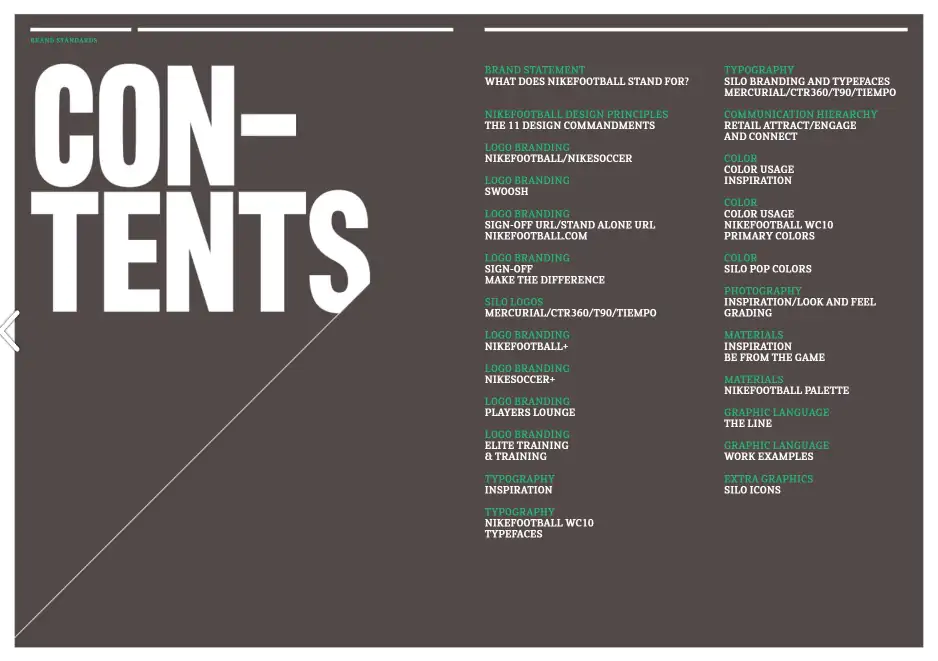
Nike’s brand book features bold, high-contrast photography and a simple, direct writing style that reflects the brand’s ethos of empowering athletes of all levels.
[Source: Nike]
Its brand book emphasizes the importance of innovation, performance and authenticity, which are key values that the brand has built its identity around.
The guidelines provide clear examples of how the brand’s visual and verbal elements should be used in various contexts, such as marketing materials, product packaging, and digital platforms.
2. Mailchimp
Mailchimp’s brand book design is colorful and playful, with a focus on approachable language and vibrant illustrations that reflect the brand’s fun and quirky personality.

[Source: MailChimp]
The document emphasizes the importance of understanding and connecting with the brand’s target audience, which is small businesses and entrepreneurs.
It also highlights the importance of storytelling, authenticity, and community building as essential components of the brand’s identity.
3. Coca-Cola
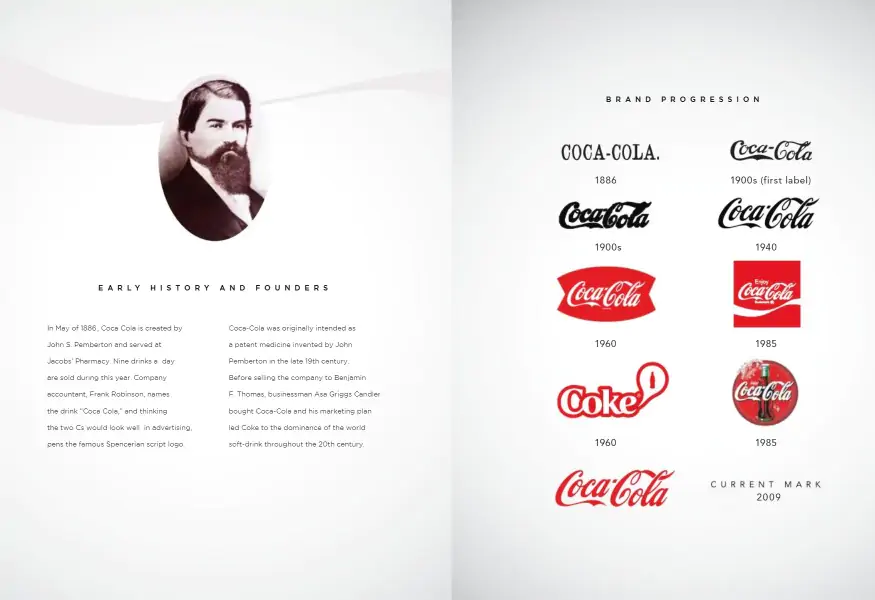
Coca-Cola’s brand book is classic and timeless, with a focus on the brand’s iconic red and white color scheme and its long-standing tradition of spreading happiness and positivity.
[Source: Coca-Cola]
One notable aspect of this document is its emphasis on storytelling.
The brand’s guidelines stress the importance of using storytelling to connect with consumers and build emotional connections with them.
Coca-Cola’s brand book also includes guidelines for engaging with consumers on social media and creating content that reflects the brand’s identity.

Brand Book Vs. Brand Style Guide
While a brand book and a brand style guide are often used interchangeably, they are different.
A brand style guide is a subset of a brand book and focuses on the visual elements of your brand, such as logo usage, typography, color palette and imagery.
On the other hand, a brand book covers all elements of your brand’s identity, including both visual and messaging components.
A brand book is a more comprehensive and detailed document than a brand style guide.
It covers a wide range of topics related to the brand’s identity and messaging, including target audience, core values, brand story and tone of voice.
Below is a detailed overview of the core differences and uses cases for both options:
| AREA OF INTEREST | BRAND BOOK | BRAND STYLE GUIDE |
| Purpose | Defines the brand’s meaning, direction and role in the business | Standardizes how the brand is visually expressed |
| Strategic value | Aligns leadership and teams around positioning, values and long-term intent | Protects brand consistency and speeds up execution |
| Scope | Covers brand purpose, audience, narrative, tone of voice, experience principles and visual philosophy | Focuses on logos, typography, color systems, imagery, layouts and templates |
| Business guidance | Shapes brand-related choices across strategy, messaging, product and customer experience | Directs how brand assets are created, reviewed and deployed |
| Lifecycle | Evolves alongside major shifts in strategy, market focus or company direction | Updated as design systems, channels or production needs change |
| When to use | Rebranding, repositioning, mergers, scaling, entering new markets | Campaign launches, agency onboarding, high-volume asset creation |
Who Should Invest In A Brand Book?
A brand book is essential for any business or organization that wants to establish and maintain a consistent brand identity.
Investing in a brand book is particularly important for businesses that operate in competitive markets, where it can be challenging to stand out and differentiate a brand from others.
By establishing a strong and consistent brand identity, businesses can build trust and credibility with customers, increase brand recognition and ultimately drive sales and revenue.
Whether you’re a small business or a large corporation, a brand book can ensure that everyone in your organization is aligned and consistent in their communication with your audience.
Design A Brand Book With Digital Silk
Designing an effective brand book takes time and patience, but it can pay off in dividends when done properly.
If you need help creating your own guidelines, our team of expert designers and branding strategists can provide those services.
Digital Silk is a full-service branding agency that specializes in building brands that excel in the digital era, with our services including:
- Premium branding solutions
- Brand and logo design
- Rebranding services
- Digital marketing
- Custom web design
Contact our team, call us at (800) 206-9413 or fill in the Request a Quote form below to schedule a consultation.
"*" indicates required fields
