








In California,The Design Is Part Of The Regulated Message
-
01The Statute Names The ElementsMost states regulate what a lawyer’s advertising says. California’s Article 9.5 — Business and Professions Code §§6157 through 6159.2, added in 1994 and effective January 1, 1995 — regulates the electronic media message as a whole, and defines that message to include the visual and structural elements a designer controls.
Under §6158, the message as a whole may not be false, misleading or deceptive, and must be factually substantiated — meaning “capable of verification by a credible source.” The definition of “message” is the part that matters for design: spoken word, sound, background, action, symbols, visual image, or any other technique.
Then §6158.1 creates a rebuttable presumption that a message is false, misleading or deceptive if it contains any of the following:
1. A case result presented out of context. Specifically, “the ultimate result of a specific case or cases presented out of context without adequately providing information as to the facts or law.” That is a direct description of the results tile grid — the row of six-figure and seven-figure numbers with a one-word case label under each.
2. A depiction of an injurious event. “The depiction of an event through methods such as the use of displays of injuries, accident scenes, or portrayals of other injurious events,” with or without sound effects. That is the hero image on a large share of personal injury websites.
3. A reference to money. “Referring to or implying money received by or for a client in a particular case or cases, or to potential monetary recovery” — including specific amounts, monetary characterizations, symbols, or wealth implications.
The word “symbols” in that third category is worth pausing on, because it means the design decision is in scope independently of the copy. A dollar sign motif, a stack-of-cash illustration, a luxury-signaling photograph — those are design choices, and the statute reaches them.
What “rebuttable presumption” actually means for a build. It doesn’t make these things illegal. It shifts the burden: use them, and the starting position is that the message is deceptive, and the firm has to demonstrate otherwise. That is a materially different risk posture from a jurisdiction where a regulator has to prove a violation — and it is the reason design decisions here should be made with the firm’s ethics counsel in the room rather than presented to them afterward.
How we build around it. Results still matter to a prospective client, so the answer isn’t to remove them — it’s to present them with the context the statute asks for. A case results module that carries the facts, the claims and the disposition alongside the number is both compliant-minded and, frankly, more persuasive than a bare figure. Imagery moves toward the firm, the practitioners and the process rather than toward the incident. And the outcome disclaimers are designed as part of the module rather than added as small print at the bottom.
None of this makes for a worse website. In practice it makes for a more credible one, because the version of a law firm homepage that leads with a crash photo and a wall of numbers is the version every competitor already has. -
02Los Angeles Is A Mass-Event Legal Market, And Sites Need To Absorb A SurgeEvery large legal market has volume. Los Angeles has something structurally different: single events that generate thousands of claimants at once, in a matter of days.
The current example is the January 2025 Eaton Fire. Nearly 1,000 lawsuits have been consolidated against Southern California Edison in Los Angeles Superior Court, Department 17 at the Spring Street Courthouse, before Judge Laura A. Seigle. The lead case, Gursey v. Southern California Edison Co. (No. 25STCV00731), was filed on January 13, 2025 — five days after the fire started. Roughly 50 bellwether cases were selected in spring 2026 covering total home loss, wrongful death, business losses and tenant claims, with the first trial set for January 25, 2027. Edison has extended more than 1,000 settlement offers through its own compensation program, and the U.S. Department of Justice filed separately seeking over $40 million.
That is one event. Los Angeles also produces mass torts, employment class actions, entertainment and IP disputes, and catastrophic-injury litigation at a scale few markets match.
For a website, that creates a requirement most law firm sites are not built for: the ability to stand up a credible, findable, high-capacity practice page fast, and to handle the traffic and intake volume that follows.
Concretely, that means a page template for event-specific litigation that can be deployed in hours rather than weeks, without a developer. Intake built to handle a spike rather than a trickle — which usually means qualifying questions on the form so the firm isn’t manually triaging hundreds of unqualified inquiries, and a clear expectation-setting confirmation rather than a generic thank-you. Infrastructure that survives the traffic when a case makes the news. And content that answers the questions claimants actually have — deadlines, eligibility, what documentation matters, what happens next — because in a mass event the firm that answers those clearly is the one that gets the call.
It also means restraint. California’s rules on solicitation and on runners and cappers are strict, and disaster-adjacent marketing draws scrutiny. The design question is how to be findable and useful to someone actively searching for help, rather than how to be aggressive toward someone who hasn’t asked. Those are different sites.
Frantz Law Group’s practice includes wildfire litigation, and the redesign we built for them was oriented around SEO, user engagement and legal authority — which is the right emphasis for a firm that needs to be found by people searching in the aftermath of an event, not pushed at them. -
03A Third Of The County Was Born In Another Country33.3% of Los Angeles County’s roughly 9.8 million residents were born outside the United States — more than double the national rate of about 14%, per 2024 data.
For a law firm website that is a build requirement, not a nice gesture. In the practice areas where LA volume actually sits — personal injury, immigration, employment, family, workers’ compensation — a meaningful share of prospective clients will be more comfortable, more confident and more likely to convert in a language other than English.
Doing it properly means real translated pages with their own URLs and metadata rather than a browser-translate widget, so the content is indexable and a Spanish-language search finds a Spanish-language page. It means intake forms, confirmations and follow-up in the same language as the page that produced them, which is where most firms break the chain. It means being explicit on the site about which languages the firm can actually serve, since promising more than the intake team can handle produces a worse experience than promising less. And it means treating language as an information-architecture decision made at the start, because retrofitting it into a finished site is expensive and usually produces something that ranks poorly.
This is one of the largest and most consistently under-served advantages available to an LA firm. Most competitors either ignore it or bolt on a translation plugin that Google treats as duplicate content.
What We Build Differently For Los Angeles Firms
The Los Angeles PracticeMix
-
01Personal Injury And Catastrophic InjuryThe highest-volume, highest-competition segment in the market, and the one most directly affected by §6158.1 — because the standard playbook here is exactly the three presumption categories. The firms that will differentiate over the next few years are the ones that stop competing on the size of the number in the hero.
-
02Mass Tort And Disaster LitigationWildfire, product, environmental. This is where surge architecture matters, and where being genuinely useful to a searching claimant beats being loud.
-
03Entertainment, Media And IPDistinctive to this market and almost the opposite build: a small, sophisticated audience, no volume intake, and a site whose job is to demonstrate standing rather than capture leads. Attorney bios, matter descriptions and credentials do the work; a chat widget actively hurts.
-
04Employment And LaborCalifornia’s employment law is among the most plaintiff-accessible in the country, and the volume reflects it. Both plaintiff and defense sides are well served here, and they need almost opposite websites.
-
05ImmigrationEnormous in this market, deeply language-dependent, and the practice area where the language architecture argument above matters most.
-
06Business And TransactionalDowntown and Century City firms selling to a business buyer, where the site functions more like a professional services site than a legal one.
-
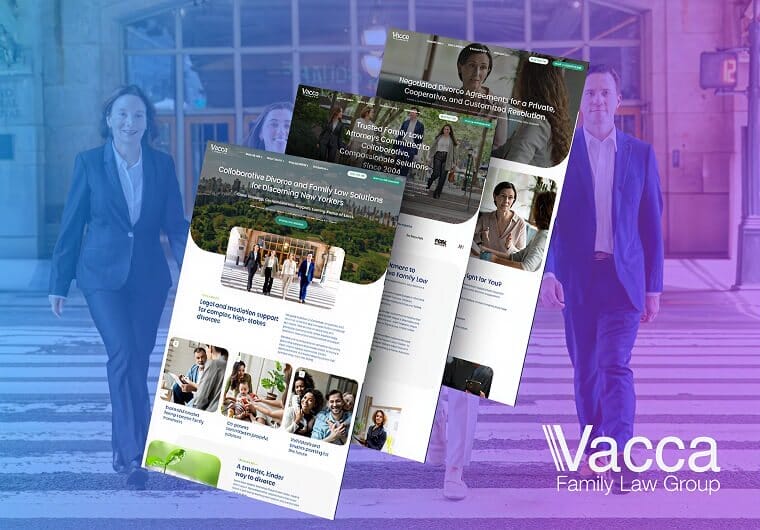
07Family LawRanges from high-volume to boutique. At the boutique end the model is authority and discretion rather than intake volume — Vacca Family Law Group is the reference in our own work, a boutique firm serving high-net-worth clients where the site was built to establish standing rather than to capture inquiries at scale. Active users rose 105.1% after launch.
Law Firm Websites We’ve Built
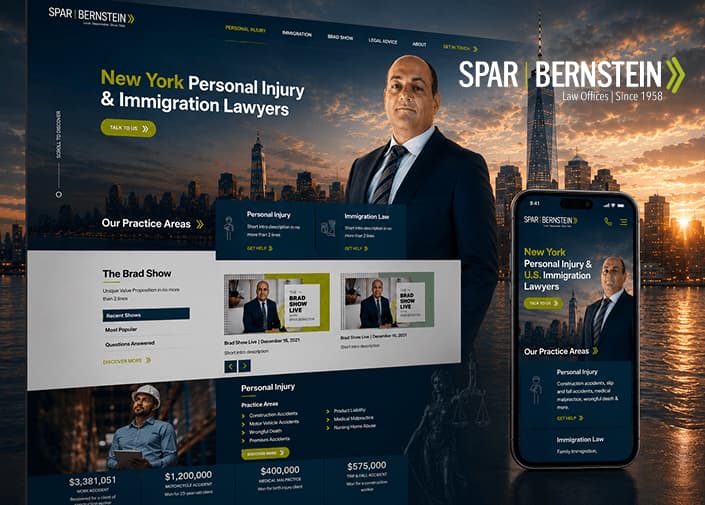
Spar & Bernstein — Legal expertise, finally surfacing in search
LawSB offers essential immigration and personal injury legal services, but limited online visibility kept it from reaching the people searching for that help.
We developed a custom SEO strategy and improved the site’s performance and UX.
In six months organic traffic grew 14x, domain rating tripled and the firm secured top-10 positions for key terms.
Vacca Family Law Group – A refined experience, for high-net-worth clients
Vacca Family Law Group guides high-net-worth clients through private, often delicate family law matters.
We designed a clean, uncluttered site with refined messaging, placing Andrea Vacca’s collaborative divorce expertise at the center.
Credibility comes through fast, lifting active users 105.1% and engaged sessions nearly 76% within four months.
Our Los Angeles Law Firm Web Design Services
We help Los Angeles firms turn their website into a source of actual case volume, not just a digital business card.

Compliance-Aware Art Direction
Design decisions made with §6158 and §6158.1 in view, so imagery, results modules and iconography aren’t creating a presumption your ethics counsel then has to rebut.

Case Results Modules Built For Context
Results presented with the facts, claims and disposition alongside the figure — the version the statute contemplates and the version prospective clients actually find credible.


Multilingual Site Architecture
Translated pages get their own URLs and metadata, indexable and rankable, with intake available in the matching language.

Accessible, High-Performance Sites
Every site is fast on mobile and accessible by design. It holds up even when a case makes local news and search volume spikes overnight.

SEO Foundations
Practice, sub-practice and location architecture that ranks. LawSB’s 14x organic growth came from exactly this kind of foundation.

Our Law FirmWeb Design Process
Here’s how our team approaches law firm web design in Los Angeles, with the state’s advertising and ethics rules folded in from the very first call.

We learn your firm, your practice areas and what’s already working across the LA market.
Your ethics counsel joins the kickoff, since in California a visual choice is often also a compliance question. We define goals and confirm the platform that fits your firm.

We map how prospective clients move through your site before any design starts. That includes wireframes, user flow and a language plan if your firm serves multiple communities.
Folding language into the architecture now avoids expensive, poorly ranking fixes later.

Some firms need a fully custom interface, others a theme tailored to the brand. We build every screen to help prospective clients reach out.
Every results module and hero concept gets checked against Business and Professions Code §6158.1 before you see it.

Our developers turn the approved design into a working site.
We handle attorney directories, intake forms and any CRM integrations it depends on. Custom functionality gets built under the same roof, so nothing gets outsourced.

Nothing goes live until we’ve tested the full site ourselves. We run every intake form and contact path across devices and browsers. We catch broken forms, buttons and disclaimers before your clients do.

Once you’re happy, the site goes live, and we watch it closely for the first few days.
After that, we track what pages get visits, where clients drop off and which practice areas convert. We use that data to keep improving the site over time.
Los Angeles Law Firm Web Design FAQs
Can we show case results on our website in California?
Yes, with care. Business and Professions Code §6158.1 creates a rebuttable presumption that a case result “presented out of context without adequately providing information as to the facts or law” is false, misleading or deceptive. That doesn’t prohibit results — it shifts the burden onto the firm.
The practical answer is a results module that carries the facts, the claims and the disposition alongside the figure, with disclaimers designed into the module rather than added underneath. Your ethics counsel makes the call; we build to their standard.
Why can’t we use accident imagery?
You can, but §6158.1 presumes it deceptive. The statute names “the depiction of an event through methods such as the use of displays of injuries, accident scenes, or portrayals of other injurious events,” with or without sound effects.
Since the same presumption attaches to money references — including symbols and wealth implications — the two most common design directions in personal injury advertising both start from a disadvantaged position in California. We’d rather build the version that doesn’t.
Does California really regulate the design, not just the copy?
More directly than most states. §6158 defines the regulated message as “the effect in combination of the spoken word, sound, background, action, symbols, visual image, or any other technique employed to create the message,” and requires the message as a whole to be factually substantiated — “capable of verification by a credible source.”
Background, symbols, visual image and technique are design decisions. That’s why we want ethics counsel in the room at kickoff.
We handle mass tort and disaster cases. What does the site need?
The ability to move fast and absorb volume. A practice page template deployable in hours when a case breaks, without a developer. Intake that qualifies at submission so your team isn’t triaging hundreds of unqualified inquiries by hand. Infrastructure that survives a traffic spike.
And content answering the questions claimants actually have — deadlines, eligibility, documentation, what happens next. The Eaton Fire consolidation reached nearly 1,000 cases in LA Superior Court with a first trial set for January 2027; firms in that space that were ready to publish on day one had an enormous advantage over firms that needed a three-week build.
Do we need a Spanish version of the site?
In most LA practice areas, yes — and properly, not as a widget. About a third of Los Angeles County residents were born outside the United States, more than double the national rate.
Real translated pages with their own URLs and metadata are indexable, so a Spanish-language search can find a Spanish-language page; a browser-translate overlay isn’t and can’t. The part firms most often get wrong is the chain after the click — the form, the confirmation and the follow-up need to be in the same language as the page.
Our practice is entertainment and business, not injury. Does any of this apply?
The advertising rules do, but the build looks completely different. You’re speaking to a small, sophisticated audience, there’s no volume intake, and the site’s job is to demonstrate standing — attorney bios, representative matters, credentials. A chat widget and a lead form actively work against you there.
