Digital Silk builds custom web development projects for Boston companies. Websites are engineered with scalable architecture, optimized code and integrations to drive greater conversions and online growth.
A Boston Web Development Agency That Helps Your Brand Grow
Complete Web Development
Creating Brand Strategies
Executing Digital Marketing Campaigns
You won’t get bounced between a design agency, a separate dev shop and a marketing team that’s never seen the project. The same people who plan your site are the ones who build and grow it, from the first strategy call through launch and beyond.
OUR WORK
Featured Boston Web Development and Design Projects
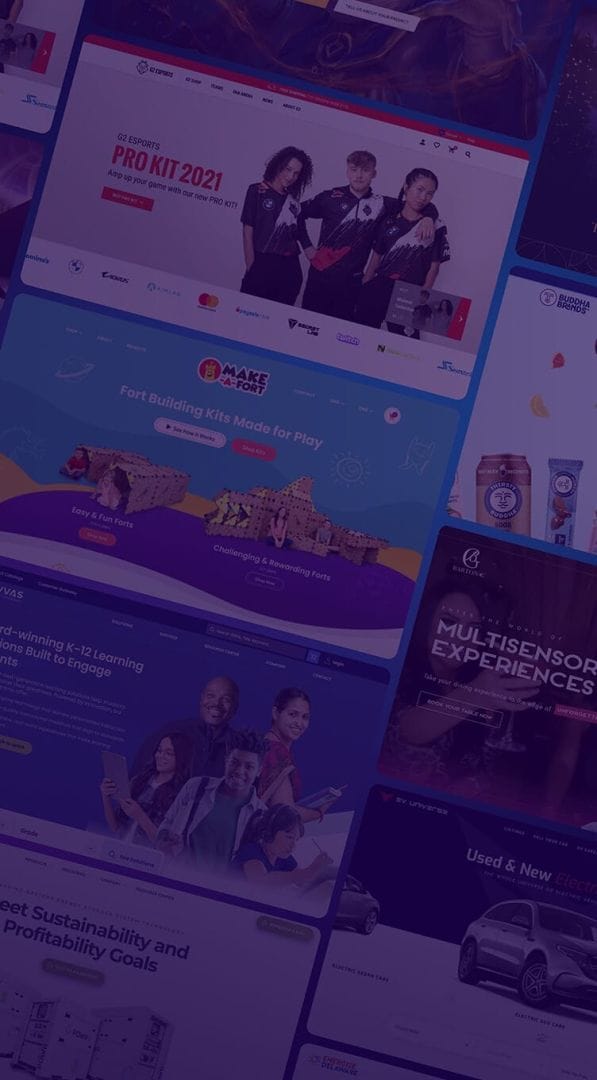
Samples of our end-to-end web development work for Boston and national clients across industries.
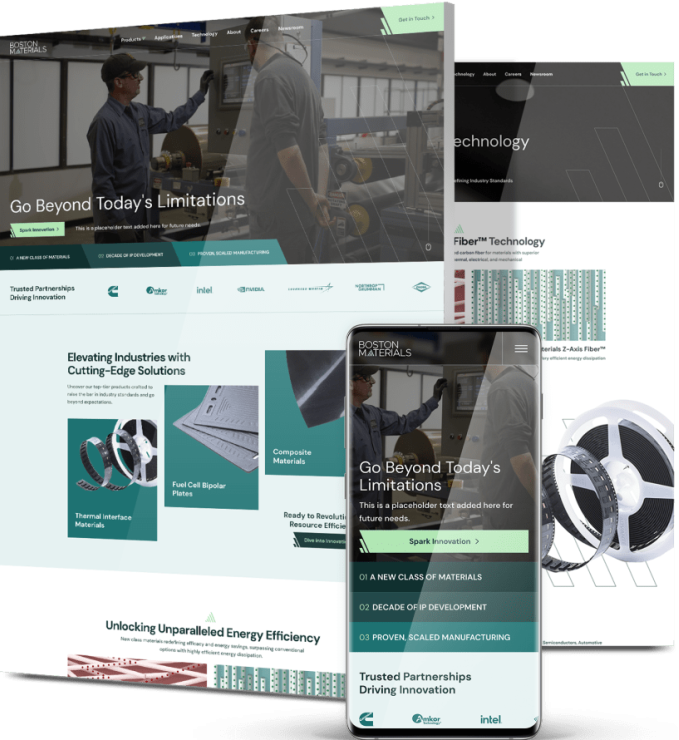
Boston Materials – Material science made legible to engineers, executives and investors at once
The issue with Boston Materials’ site was that it was trying to explain the same concept to both engineers and investors in one single page.
Digital Silk built separate content pathways for engineers, executives and investors, then used motion graphics and interactive visuals to carry the science without burying it.
Active users rose 41.14% after the June 2024 relaunch. They also saw a 31.16% increase in organic traffic and nearly a 20% increase in engaged sessions.
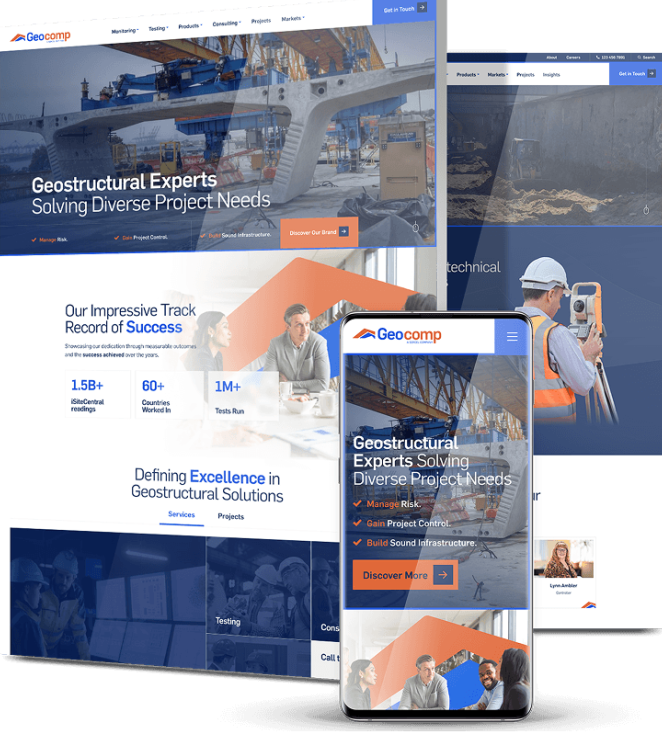
Geocomp – A brand rebuilt first, then a site worthy of the engineering behind it
Geocomp’s site struggled with inconsistent identity, unclear structure, and an overall lack of design uniformity.
We started with the brand rather than the pages: new logo, brand book and style guide, then designed the site on top of that system. A deep catalog of geotechnical and geostructural services got organized into routes a visitor could actually follow.
Project work then moved to the front, with flexible templates built around what clients want to know, clearer calls to action and a dynamic locations map to handle the conversion side.
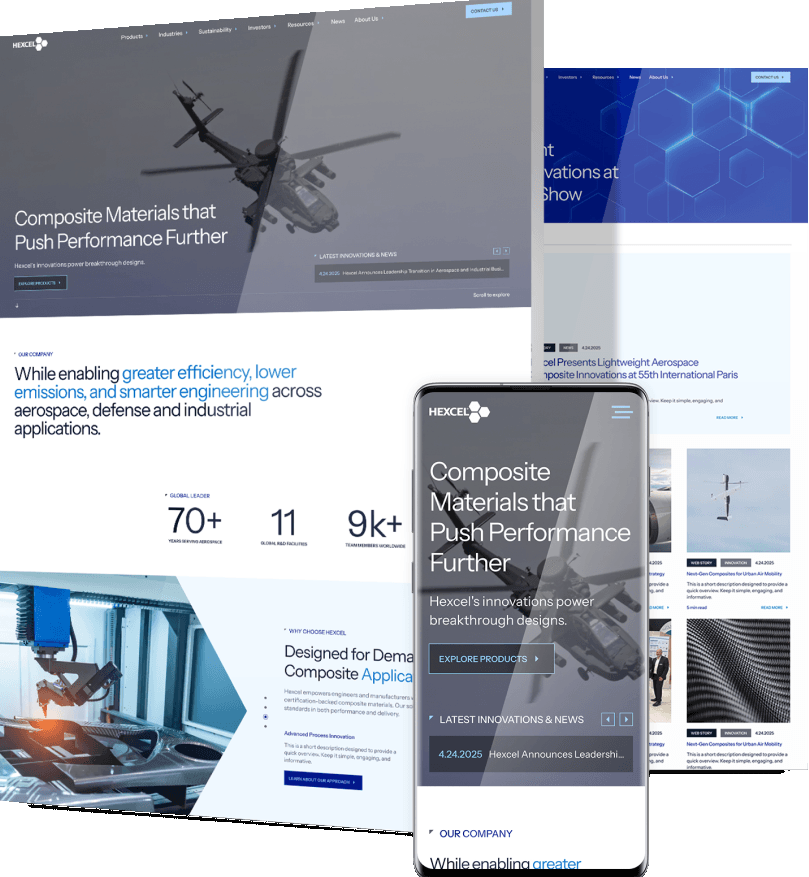
Hexcel – Technical depth turned into engagement, with a 132% lift in active users
Engineers, procurement teams and partners all had trouble locating the materials, technologies and specifications they came for.
Our team reorganized the product and technology architecture, then built content pathways that pull technical audiences deeper into applications and supporting documentation rather than stalling them at a category page.
Measured against the prior period after the February 2026 launch, active users climbed 132%, engaged sessions 76.52% and returning users 70.1%.
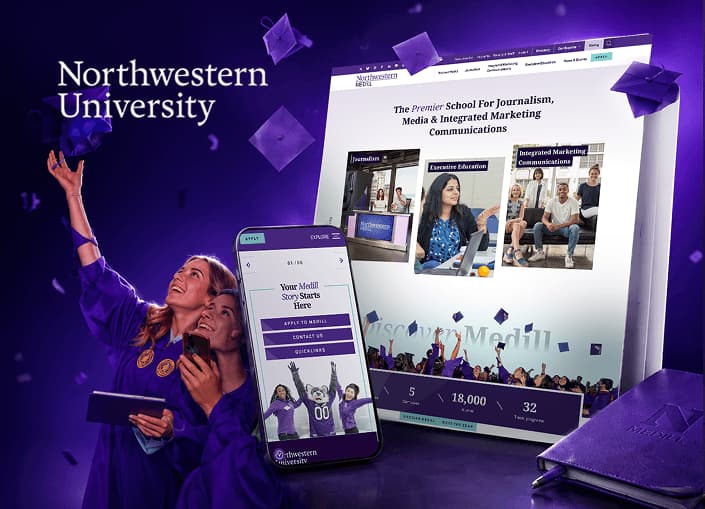
Northwestern Medill – One platform, five audiences, a century of reputation to carry
Undergraduate applicants, graduate applicants, IMC professionals, IMC full-time students and short-course learners were all funneled through one undifferentiated site.
Digital Silk ran the full strategy engagement first: competitor audits against UNC, Berkeley, Columbia, USC, NYU and CUNY, personas per program, and a school-wide value proposition built on the alumni network and career outcomes. Then we built it.
Ten landing page designs, five distinct audience journeys, a stat-driven homepage putting 104 years, 5 campuses, 18,000 alumni and 32 travel programs front and center.
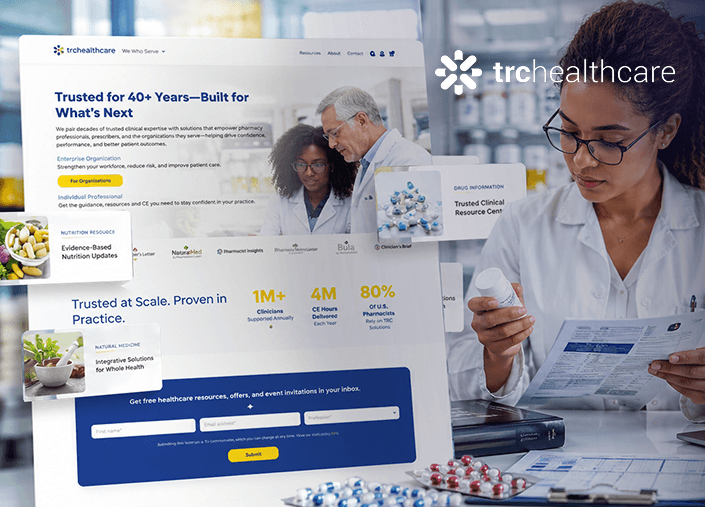
TRC Healthcare – Pharmacy education, with a distinct path for every audience
Pharmacists, technicians and prescribers all use this content and all need different things from it. A single content tree serving all three would force every audience to read around the other two.
We built the backend to keep product lines and their accreditation requirements structurally separate, so breadth stopped being a liability.
When a regulatory update lands, it publishes to the lines it applies to. Nobody copies it five times and hopes.
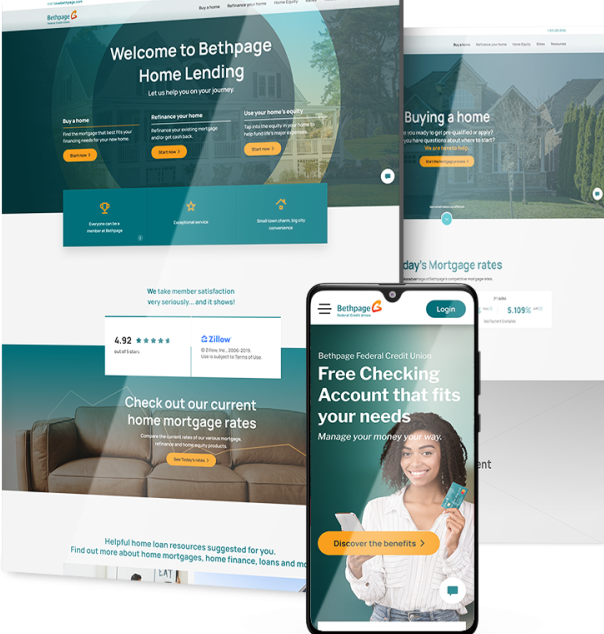
Bethpage Federal Credit Union – Personal and business banking, separated into funnels that convert
One of the Northeast’s largest credit unions, repositioning for a younger membership with a site that wasn’t built for either the brand or the audience.
Messaging was written to support each journey rather than to describe the institution. User acquisition rose 4,200%.
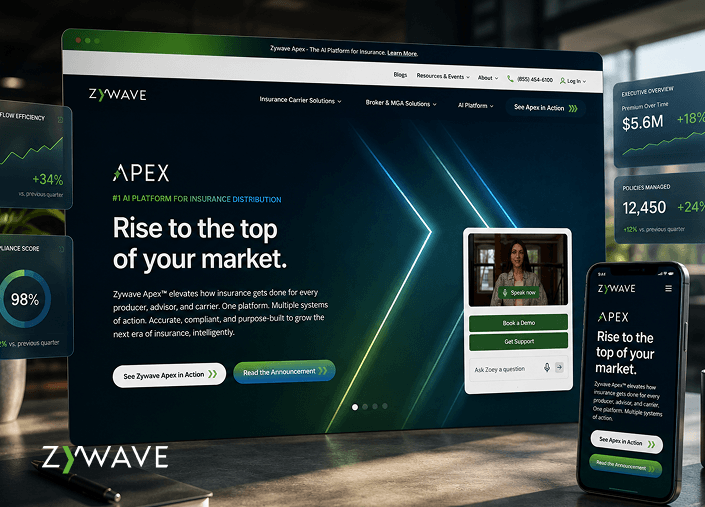
Zywave – 135% more lead submissions from the traffic they already had
The site led with more than twenty solutions upfront, organized around internal product categories rather than what brokers, insurers and service providers were actually trying to do.
We ran a phased, CRO-driven redesign across the homepage, audience hubs, product pages and resource experiences, moving the architecture from product-first to audience-first.
Within five months, monthly lead form submissions rose roughly 135%, converting users per month over 115% and homepage click engagement about 60%.
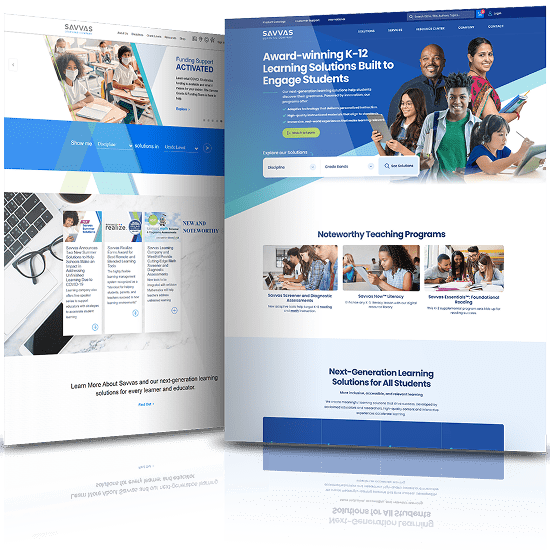
Savvas Learning Company – Support that starts with the task, not the job title
The old support flow opened by asking who you were. Teachers, administrators and technical users then navigated a path built around roles rather than around what they’d come to do.
We rebuilt the architecture around tasks instead, changing the entry point from “Who are you?” to “What do you want to do?” It sounds small. It reorganizes the entire flow.
Before anything shipped, we built an interactive prototype, defined six real scenarios and ran remote testing with 11 teachers and school administrators, tracking success rates and ease of use.
Our Clients
The Best Boston Web Development Company
We have partnered with various businesses across multiple industries to engineer, plan, and execute their digital strategy.
From first conversation to finished product, here’s how we build.
01
Building Out a Web Strategy
We don’t start building until we know what success looks like for you.
We research your market, look at who you’re competing with in Boston and nationally, and talk to your team about what has worked and what hasn’t.
On technical projects we also find out early who holds veto power over a page, because that’s rarely one person and they rarely agree.
That research shapes the entire web development strategy going forward.
02
Planning & Defining the Architecture
At this stage we map out how your site will work.
Our team builds user flows, creates your sitemap and wireframes the key pages so the structure supports conversions from the start.
Boston sites usually serve several audiences at once, so we architect each path explicitly rather than building one and bolting the rest on.
If a visitor has to think too hard about where to click next, something went wrong in this phase.
03
Custom Design
Your site should feel like your brand the second someone lands on it.
Our designers create custom layouts with anything from illustrations and animations to interactive features that pull people through the page.
We design against your real content too, not placeholder text, because dense technical content is where most design systems break.
Accessibility and SEO get built in from day one, because a site nobody can find or use isn’t doing its job no matter how good it looks.
04
Responsive Development
More than half your traffic is probably coming from a phone.
Our web development services team builds every site to perform across all screen sizes and devices.
We pull insights from user behavior and touchpoint data, turn approved designs into a flexible front end and test everything properly, including against assistive technology, so the experience holds up no matter how someone finds you.
05
Launch & Ongoing Support Services
We have a launch protocol for a reason. We’ve done this enough times to know what can go wrong, so we plan around it.
After launch, our support services keep things running with security patches, performance checks and updates when you need them. We also document how the CMS is put together so your team doesn’t have to call us for routine work.
We stay involved long after the site goes live.
I would absolutely work with Digital Silk again on future projects and would recommend them to anyone looking for a team that knows what they are doing but is also made up of really good people.
There are over 6 million websites running on WooCommerce.
WooCommerce fits when commerce is secondary to content. You keep one system, one login and one content model instead of running a store beside a site and syncing them forever.
We keep track of every possible metric, such as bounce rate and where users drop off, to plan how to proceed moving forward and what steps we need to take next.
Five-Star Reviews
Backed by Clients Who’d Say So Publicly
Our Clutch and DesignRush reviews converge on three things, and it’s always the same three: we communicate, we hit dates, and the thing we shipped works.
Project Ownership
One Team From Scope to Ship
You dream it, Digital Silk builds and brings it to life. We drive the project, you keep the final call.
Constant Support
Support Through the Launch
We plan for what happens during and after launch: how new pages get added and how they will impact the existing structure.
Meet With Our Trusted Boston Web Developers
Tell us what you’re building and what’s currently in the way. You’ll get a scope, a timeline and a number, not a template proposal.
Subscribe to our newsletter to get the latest industry insights and web development best practices delivered to your inbox.
"*" indicates required fields
Boston Web Development Company FAQs
What makes Digital Silk different from other web development companies in Boston?
Strategy, design, engineering, QA and support sit under one roof, so nothing gets lost in a handoff between an agency and its subcontractor.
You get a named team rather than a rotating pool, and the people who scoped your project are the ones who build it.
We don’t work from templates. That’s the reason our timelines are honest and also the reason we’re not the cheapest quote you’ll get.
Do you have a Boston office?
No. Miami, New York, Chicago and San Diego.
We work with Boston clients remotely and we’re on Eastern Time through the full day, so you’re not waiting overnight for answers.
We can travel for kickoffs and workshops when the project warrants it.
How long do web development projects take?
The variable that moves timelines most isn’t page count, it’s approval chains and integrations.
A marketing site with three stakeholders and one CRM connection moves quickly. A site with clinical or legal review, six systems to integrate and multilingual content does not, and anyone quoting you a duration before understanding that is guessing.
We give you a real timeline after discovery, with the review cycles built into it rather than assumed away.
What tech stack does your team build on?
WordPress, Shopify, Adobe Commerce and WooCommerce, with React for headless and application front ends, and custom PHP work where a platform isn’t the answer.
The recommendation follows your content model and your team’s capacity, not our preference.
Can you redesign an existing website or do I need to start from scratch?
Depends what’s underneath the design.
If your platform and data structures are sound, a redesign is cheaper and faster and we’ll say so. If the codebase is the reason you’re stuck, a redesign just repaints the problem and you’ll be back in eighteen months.
We audit first: content, data structure, integrations and accumulated SEO equity. Then we tell you which one you’re actually looking at.
What happens after my site launches?
Security patching, uptime and performance monitoring, backups, and optimization based on how the site is actually being used.
Hosting is available if you want it consolidated, and our marketing teams can pick up traffic growth from there.
We also hand over documentation, because a client who can’t make a routine edit without us is a client we’ve failed.
How involved do I need to be during the project?
Three points need you specifically: strategy, design approval and content sign-off. Everything else can run without you if that’s your preference.
We set the schedule at kickoff so you know when those moments land, and nothing proceeds past them without your yes.
If something needs a decision, we ask directly rather than assuming and hoping.
Do you handle third-party integrations?
Yes, and it’s usually the least glamorous, most consequential part of a build.
We helped Unity Environmental University deploy Salesforce Agentforce, the first implementation at a U.S. institution, so the complicated end of this is familiar territory
How much does a web development project in Boston cost?
It depends on platform, integration count and content volume more than anything else. A WordPress marketing site and an Adobe Commerce build with an ERP feed aren’t priced on the same scale, so we don’t quote off a page count.
We give you a real number after discovery, not a range pulled from a rate card.
Do you work with Boston companies outside of Massachusetts too, or is this Boston-specific?
We work with Boston-based teams and companies with a Boston presence serving New England markets.
The engagement model doesn’t change based on geography since everything runs remotely with the same named team either way.
Will my site be built to scale as my business grows?
That’s the point of the architecture phase. We plan for the pages, integrations and content types you’ll need in a year, not just what launches on day one.
Templates get built flexible enough that your team can add pages without calling us every time.
What if I already have a development team in-house?
We’ve partnered alongside internal teams plenty of times. Sometimes that means we handle strategy, design and build while your team owns ongoing edits. Sometimes it’s the reverse, with us brought in for a specific platform migration or integration your team doesn’t have bandwidth for.
We scope around what your team already covers so we’re not duplicating work.
How do you handle SEO during a rebuild so I don’t lose my rankings?
We audit accumulated SEO equity before anything gets touched: existing rankings, backlink profiles, URL structures and indexed content.
Redirects get mapped before launch, not scrambled together after someone notices traffic dropped.
Can you help with ongoing content updates after launch, or is that on us?
Both are on the table. We hand over documentation so your team can make routine edits without us, but if you’d rather not staff that internally, our support services cover ongoing updates too.
We ask which one you want at kickoff rather than assuming.
What industries in the Boston area do you have the most experience with?
We’ve worked with Boston Materials and Geocomp, the former of which is a advanced materials and manufacturing company, and the latter a Geotechnical engineering, testing, and infrastructure monitoring firm.
We’re not limited to any vertical, but a lot of web development is mainly for research institutions, healthcare, financial services, manufacturing and software companies, largely because Boston’s economy leans that direction.
The common thread across those industries is usually complex content and multiple audiences, which is where our architecture work tends to matter most.
Stay Ahead in 2026!
Download the Top Digital Trends Shaping Branding & Web Development