8 Signs You Need eCommerce Website Maintenance Services
Slow pages, broken checkouts and stale plugins cost you sales. Here are 8 signs your store is overdue for eCommerce website maintenance services.


-
Maintenance debt collects interest. A skipped patch in March turns into a ranking slide in June and a card-skimming script by September and nothing at the time tells you they’re connected.
-
Platform support stops where your store begins. Shopify keeps its servers running, but your theme, your apps and your checkout belong to you.
-
Your customers shouldn’t be your error log. Monitoring flags a 2 a.m. payment failure in minutes, while a support email reaches you after a week of lost orders.
-
Fixed problems beat bought traffic. Across our eCommerce case studies, the biggest lifts came from repairs to checkout, mobile navigation and catalog structure, not from more ad spend.
Your online store works fine right up until the day it doesn’t. A broken coupon field, a slow product page or an expired app can drain revenue for weeks before anyone notices something’s wrong.
The stakes keep climbing, as nearly every US adult will shop online by 2030 in the U.S.
Every one of them will judge your store in the first few seconds after they land on it.
8 Signs You Need eCommerce Website Maintenance Services
There are more than 24 million eCommerce websites online right now, so a shopper who hits a problem on yours has thousands of alternatives a tab away. The warning signs almost always show up on the site months before they show up in your revenue report.
1. Your Product Pages Take Longer Than 3 Seconds To Load
Most store owners test their homepage and call it a day. Test a product page instead, ideally one with a size chart, a reviews widget and a shipping calculator on it, because that’s the page your customers actually use.
Free tools like Google PageSpeed Insights or GTmetrix will give you a load time and a list of what’s slowing the page down, and the mobile score usually tells the uglier story.
Slow pages usually come from stacked third-party scripts, oversized product photos uploaded straight from a photographer’s folder and apps you installed for a campaign two years ago and never removed. Pull a list of every script running on your site and ask what each one earns you.
2. Shoppers Fill Their Carts, Then Vanish At Checkout
Cart abandonment happens to everyone, but a sudden jump means something on your site broke. Common culprits: a payment method that fails silently on one browser, a shipping rate that returns an error at step three or an address field that rejects apartment numbers.
Absolute Dogs came to us with a checkout so convoluted that customers struggled to add items to their cart at all.
Our Shopify rebuild of the checkout experience lifted add-to-cart actions by 77.88% and completed purchases by 35.63% in the first month.

eCommerce website maintenance services catch these breaks through routine test transactions, not through customer complaints.
3. Your Mobile Experience Falls Apart Before Anyone Sees A Product
Phones drive most eCommerce traffic now, yet a lot of stores still get built and reviewed on a desktop monitor. Watch for tap targets that sit too close together, filters that open a panel you can’t scroll and hero images that push products below three swipes of content.
ZipTie had exactly this problem, with 87% of visitors leaving before they ever reached a product page. Our mobile-first Shopify Plus rebuild brought a 611% surge in mobile sessions and a 353% lift in conversion rate inside 30 days.

4. Your Catalog Grew And Your Navigation Didn’t
A store that launched with 40 products and now carries 400 usually has the same menu it started with. Shoppers end up scrolling through one long list, and your best items sit five clicks deep where nobody finds them.
ANRKY Wheels had thousands of custom builds on its site with no way to browse by model, finish or configuration, so we restructured the catalog into a searchable gallery and paired it with an SEO foundation for luxury wheel searches.

Organic traffic climbed about 40% and keywords in the top three positions grew more than 15 times over. Good eCommerce website maintenance services treat your category structure as something that evolves with your inventory.
5. Every New Product Drop Waits On A Developer
If launching a seasonal collection means filing a ticket and waiting two weeks, your platform has stopped keeping pace with your business. The cost isn’t just the dev invoice. It’s the campaign you skip because the page won’t be ready in time.
G2 eSports ran into this with no template system for new team, player or product pages and an average load time of 6.23 seconds, so we rebuilt the store on a modular, template-driven CMS that lets the marketing team publish without touching code.

6. Your Apps, Themes And Plugins Are Months Behind
Every app you install adds code someone else maintains, and some of those developers walk away from their products entirely.
Outdated extensions are the most common way attackers slip card-skimming scripts into a store, and they’re also the reason a theme update suddenly breaks your product filters.
Check your app list quarterly, uninstall what you no longer use and confirm the rest still get updates. eCommerce website maintenance services keep a version log so you know what changed on the day something broke.

7. Your Stock Levels, Prices And Shipping Rules Disagree With Each Other
Nothing burns trust faster than selling something you can’t ship.
When your store, your inventory system and your fulfillment tool fall out of sync, customers see items in stock that left the warehouse days ago, or they get charged a shipping rate that doesn’t match what checkout promised.
Run a real purchase through your own site once a month, all the way to the confirmation email, and compare what your systems say against what the customer sees.
Most sync problems announce themselves in a refund queue long before anyone opens a support ticket.
8. You Find Out About Problems From Your Customers
By the time someone emails you about an error at checkout, you’ve probably lost a week of orders from everyone who didn’t bother to write. Uptime monitoring, error logging and automated checkout tests give you a heads-up in minutes instead.
Ask yourself a simple question: if your payment gateway failed at 2 a.m. on a Saturday, who would know, and how fast? If the answer involves a customer, ongoing eCommerce website maintenance services would pay for themselves on the first incident.

The Importance Of eCommerce Website Maintenance Services
Maintenance rarely feels urgent until it costs you a weekend of sales. Treated as a habit instead of a rescue mission, it protects the revenue you’ve already earned and the traffic you’ve already paid for. Here’s what consistent upkeep gives you.
1. You Keep The Sales You Already Paid To Win
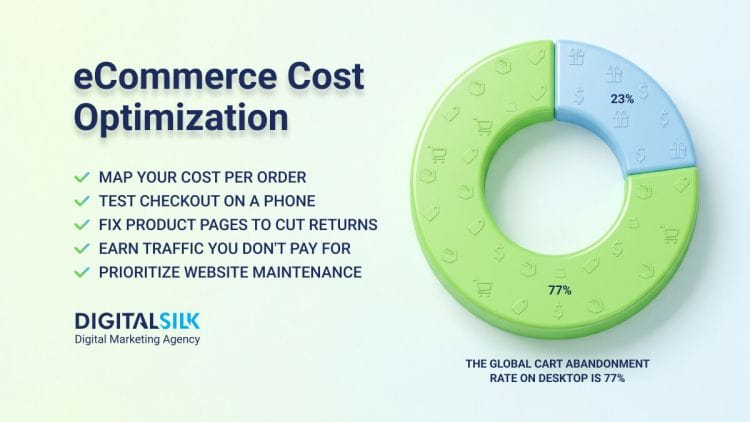
The average eCommerce cart abandonment rate sits at 70.22% in 2026, which means most of your ad spend goes toward people who leave before they pay.
Some of that is normal browsing behavior, but a meaningful slice comes from problems you can fix: slow payment steps, surprise fees and forms that reject valid data.
Fixing those costs far less than buying more traffic to replace the customers you lost. Every point you claw back applies to every campaign you run afterward.
2. You Protect Customer Data And Your Ability To Take Payments
Online stores hold names, addresses and payment details, which makes them a standing target. A single injected script can harvest card numbers for months without visibly changing your site.
Regular patching, access reviews and malware scans close the doors attackers use most. Beyond the breach itself, losing your payment processor over a compliance failure can shut down sales entirely.
3. You Hold Your Search Rankings Instead Of Rebuilding Them
Google notices slow pages, broken links and products that return errors, and rankings slide gradually enough that nobody connects the drop to a plugin update three months earlier.
Discontinued products left without redirects turn old links into dead ends and waste the authority those pages built.
Routine crawls catch these issues while they’re still small. Recovering a lost ranking almost always takes longer than protecting it did.
4. You Keep Pace With A Market Moving Online
eCommerce passed 19% of global retail sales in 2023 and is forecast to reach nearly 23% by 2027, which means your website will carry more of your revenue every year, not less. A site that can’t handle a traffic spike or a new payment method puts a ceiling on your growth.
Ongoing upkeep lets you adopt new tools, markets and buying habits as they arrive. Stores that wait for a full redesign every five years spend those years falling behind.
5. You Spend Less Than You Would On Emergency Fixes
Rush development work costs more, arrives later and skips the testing that prevents the next problem.
A planned maintenance schedule spreads that work across the year and catches small issues before they turn into outages.
You also keep institutional knowledge with a team that already knows your setup. Nobody has to reverse-engineer your site while your store sits down.

The Most Important Website Maintenance Elements To Track
Maintenance covers a wide range of work, and not all of it carries equal weight for an online store. These are the areas worth watching on a set schedule.
- Security patches and updates: Apply platform, theme and app updates on a fixed cadence so vulnerabilities don’t sit open for months.
- Backups and restore tests: Run automatic backups and actually restore one occasionally, since an untested backup isn’t a backup.
- Page speed and Core Web Vitals: Track load times on product and checkout pages, not just your homepage.
- Checkout and payment testing: Place a real test order across browsers and devices every month, including a refund.
- Broken links and redirects: Map discontinued products to relevant alternatives so customers and search engines land somewhere useful.
- Uptime and error monitoring: Set alerts that reach a human within minutes of an outage or a payment failure.
- App and extension audits: Review every installed app quarterly and remove anything abandoned or unused.
- Accessibility checks: Test keyboard navigation, contrast and screen reader labels to keep your store usable for every shopper.
Experience eCommerce Website Maintenance Services With Digital Silk
We design, build and support eCommerce stores, so our maintenance work comes from knowing how a high-performing store should run in the first place. Our team handles security, performance, platform updates, product data and conversion testing, and we report on what we changed and what it moved.
If your store has shown you two or three of the signs above, you’re already losing sales to problems with known fixes. We’ll audit what you have, tell you what’s costing you revenue and give you a plan you can act on.
Contact our team, call us today at (800) 206-9413 or fill in the Request a Quote form below to tell us about your project and start your eCommerce project today.
eCommerce Website Maintenance Services FAQs
What do eCommerce website maintenance services include?
Most plans cover security patches, platform and app updates, backups, uptime monitoring, page speed work, broken link repairs and checkout testing.
Better ones also watch product data accuracy, conversion tracking and accessibility.
How often should I update my online store?
Apply security patches within a few days of release, since published vulnerabilities get exploited fast. Run app and theme updates monthly on a staging copy first, then push them live once you’ve confirmed nothing broke.
Review speed, navigation and checkout performance every quarter. A deeper audit of your platform, integrations and site structure once a year keeps larger problems from piling up.
Can my own team handle maintenance in-house?
Smaller stores manage it fine as long as one person owns the work and it lives on a calendar rather than a wish list.
The trouble starts during busy months, when updates slip and nobody notices until something breaks during a promotion. Many brands split the work, handling content and product updates internally while an agency covers security, performance and development.
How often should I test my checkout?
Run a full test order at least once a month, and again after any change to your theme, apps or payment settings.
Test on a phone and a desktop, across at least two browsers, using each payment method you accept. Push one order through to a refund as well, because refund failures generate support tickets and chargebacks that never show up in your conversion data.
Is platform support the same as ongoing maintenance?
No. For instance, Shopify, your host and your payment gateway fix problems on their own side of the line, like outages, account issues and platform bugs.
None of them will update your theme, audit your apps, fix your mobile navigation or tell you your checkout drops Safari users. That work belongs to you or to a maintenance partner who knows your build.
How can I tell if my store has been compromised?
Watch for admin accounts nobody recognizes, theme files changed on a date when nobody was working, customers reporting redirects to unfamiliar sites and browser warnings on your own domain.
A sudden rise in chargebacks or a drop in completed checkouts can also point to skimming code. If you suspect a breach, rotate every credential, restore from a clean backup and contact your payment processor.
Do I still need maintenance on a hosted platform like Shopify?
Yes. Shopify maintains the platform itself, meaning servers, core code and security at the infrastructure level.
Everything you added sits outside that: your theme, your apps, your product data, your custom code and your integrations. Those pieces break, fall out of date and conflict with each other, and hosted platforms won’t flag any of it for you.
How quickly will I see results from maintenance services?
Speed and checkout fixes usually show up in your analytics within days, since you’re removing obstacles from people already trying to buy.
Security and backup work pays off in problems you never experience, which makes it harder to measure but no less valuable. Search recovery moves slowest, often taking a full quarter before rankings and organic traffic respond.
Tell us about your website goals and let our experts give you a custom proposal
"*" indicates required fields