
Landing Page Design: Best Practices & Examples
The best landing pages are built for one job: turning a click into a customer. Our team breaks down the anatomy, types and best practices behind landing page design that actually converts.


-
Match the message before anything else: A disconnect between the ad that brought the visitor and the page they land on is one of the fastest ways to lose a lead. Every element, headline, CTA and offer, needs to reflect exactly what was promised.
-
Three to four form fields is the ceiling: Reducing form length is one of the single highest-impact optimizations you can make. More fields means fewer completions, every time.
-
One CTA per screen, every time: Competing calls to action on the same screen create decision paralysis. One visible area, one action, one button, and that button needs to contrast with everything around it.
-
Start simple, scale with data: A landing page does not need to be a full website. Many high-performing pages begin lean and grow as real user behavior shows what to build next.
43.6% of marketers build landing pages specifically to generate leads. Most of them struggle to convert because the page structure, messaging and flow were not thought through before the design started.
[Source: HubSpot]
Sara Lerota from Digital Silk‘s Business Development team has seen what works and what doesn’t. We asked her to walk us through the anatomy of a high-performing landing page, from the first fold to the final form field.
1. What Makes A Landing Page Design Convert?
Effective landing page design is purpose-built around a single conversion goal.
Unlike a full website, it strips away navigation menus, competing links and secondary content to keep the visitor focused on one action: filling out a form, booking a call or making a purchase. With conversion rates varying widely by industry, the design of the page makes all the difference.
According to a report from First Page Sage, Legal Services landing pages convert the most, at 3.4%, while Automotive and Aviation convert the least, at just 1.0%.
A high conversion rate doesn’t make those leads cheap, though.
Legal also pays the highest cost per click of any industry in Google Ads, which is why our law firm PPC work keeps forms short but makes one or two of the fields qualifying questions, like case type or jurisdiction, so firms aren’t paying premium prices for matters they can’t take.
[Source: First Page Sage 2026 Report]
The core conversion levers come down to four things:
- Message match: The page delivers exactly what the ad or link promised.
- A clear value proposition: Visitors understand what’s in it for them before they scroll.
- One focused CTA: A single, contrasting action per screen, with no competing options.
- A short form: Three to four fields, with trust signals close by.
2. What Is The Anatomy Of A High-Converting Landing Page Design?
Every element of a landing page design should earn its place in the conversion funnel. Here’s what a high-performing page looks like from top to bottom:
- Hero section: The headline communicates the unique value proposition immediately. A supporting line adds context. A clear CTA button sits above the fold.
- Value proposition: Specific, benefit-led and visible without scrolling. Not “API integration”, but “save 5 hours a week.”
- Social proof: Testimonials, star ratings, client logos and third-party badges. Placed near the CTA, not buried at the bottom.
- Primary CTA: One per visible screen area. Action-oriented copy (“Get your free quote”) rather than passive labels (“Submit”).
- Form: Three to four fields maximum. Every additional field reduces completion rates.
- Trust signals: Security badges, review scores and partner logos near the form and buy buttons.
- Footer: Keep it minimal. No full navigation. A privacy policy link and contact details at most.
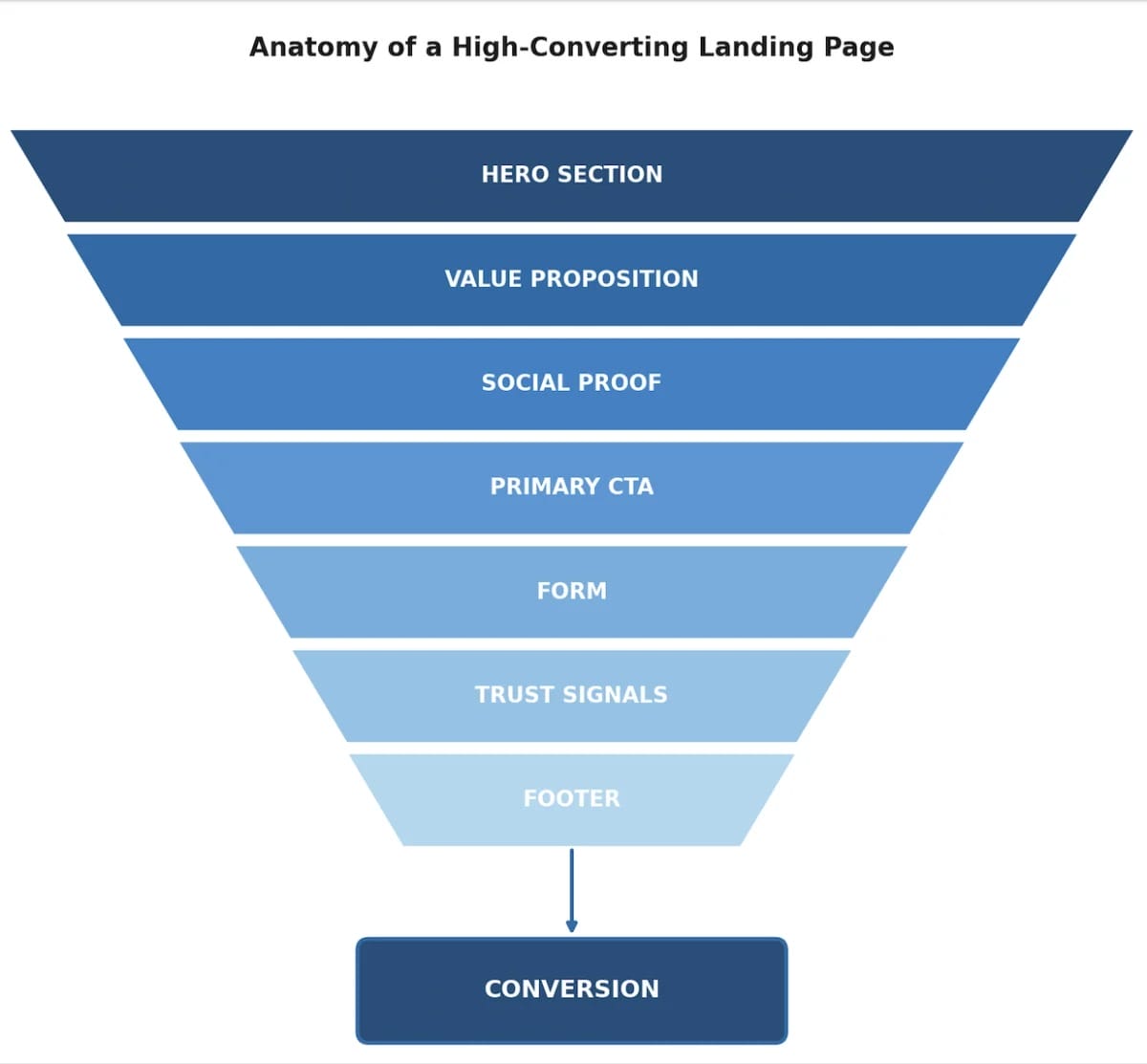
Unclear navigation is one of the primary drivers of site abandonment. A landing page optimization sidesteps that problem by design: when there is nowhere else to go, visitors stay focused on the one action you want them to take.
3. When Does A Brand Need A Landing Page Vs. A Full Website?
It depends. Sometimes all they need is a landing page. It covers what they want to share with their audience, it’s simple, it’s straightforward and it gets the job done.
Sometimes it’s a bigger client with multiple specific subsections within the company. They might have their own high converting landing pages for each segment, which can be tweaked and changed by their internal team over time.
And something beautiful happens: clients often start with a landing page and as the brand grows, they upgrade to a full website design. It’s always good to have that option. You can start with something simple and add complexity later, as the data tells you what to build next.
“If you want to present your brand in the simplest way possible, a landing page design is the way to go. It’s sharing what you offer without any distractions: very straightforward and it gets the job done.” Sara Lerota, Business Development Team
4. What Are The Best Practices For Landing Page Design?
From my experience at Digital Silk, these are the best practices I consistently rely on when designing high converting landing pages. Strong landing page design balances conversion principles, user experience and message clarity to move visitors toward action.
These insights are supported by research from Think with Google and the Baymard Institute.
| Best Practice | Why It Matters | Quick Example |
| Single, clear goal | Competing goals split attention and lower conversion | One CTA per page: “Book a free consultation” |
| Value prop above the fold | Visitors form opinions in under 3 seconds | Headline visible on load, before any scroll |
| Benefit-led copy | Benefits connect to the customer’s outcome, features don’t | “Save time” over “API integration” |
| One primary CTA per screen | Competing CTAs create decision paralysis | A single contrasting button per visible area |
| Action verbs in CTA copy | Specific, action-led copy tells visitors exactly what happens when they click | “Get your free quote” instead of “Submit” |
| 3–4 form fields only | Each additional field reduces completion rates | Name, email, phone: nothing more unless essential |
| Mobile-first layout | More than half of web traffic is mobile | Full conversion funnel working on small screens |
| Fast load time | Slow pages lose visitors before they convert | Target under 3 seconds, compress images, minimize scripts |
| No competing navigation | Full nav menus give visitors an exit before they convert | Remove the main menu, keep only logo and CTA |
| Message match with the ad | Visitors click expecting a specific promise | Ad says “50% off” – the page leads with that offer |
| Whitespace over decoration | Clean layouts guide the eye, clutter competes with the message | Space around headlines instead of boxes and borders |
Some of the most effective lead capture pages blend these formats.
For NASCAR, one of the projects in our lead generation case studies, we built an interactive quiz that matched fans with the Cup Series driver they’re most like, collecting their details upfront and tailoring the questions to whether they were new, casual or avid fans.
5. What Are The Main Types Of Landing Page Design And When To Use Them?
Not all landing page examples serve the same purpose. The right format depends on your campaign goal, your audience’s level of awareness and what action you want them to take. Different landing page design formats support different campaign objectives and stages of the buyer journey.
| Type | Primary Goal | Best For | Key Elements |
| Lead generation | Capture contact information | B2B services, consultations, demos | Short form, strong UVP, trust signals |
| Click-through | Warm up the visitor before the next step | eCommerce, SaaS free trials | Benefit-led copy, single CTA to product/checkout |
| Sales / long-form | Close the deal on the page | High-ticket products, complex services | Full objection handling, testimonials, detailed benefits |
| Squeeze page | Capture email in exchange for a resource | Lead magnets, newsletters, downloads | Minimal copy, one field, clear incentive |
| Event / webinar | Drive registrations | Conferences, live or recorded events | Date/time prominent, social proof, urgency |
| App download | Drive installs | Mobile apps | App store badges, screenshots, short benefit list |
6. What Separates Effective Landing Page Design From One That Doesn’t Convert?
It’s a combination of factors, it’s not just one thing. On one side, it’s one single clear goal. On the other, the value proposition needs to be synced with the ICP, which is your ideal client profile. You need to know who you’re targeting and then relay that message on the page.
We all have the attention span of a goldfish, so you need to capture attention right away. That’s why the value proposition has to be visible in the hero section before any scrolling.
It’s also important to focus on the benefits the audience is getting, not just a list of features. If I’m visiting a page and I don’t understand what’s in it for me within the first few seconds, I’m gone.
“When we connect the unique value proposition with the ideal client profile, we arrive at product-market fit. If we don’t have that, it will impact the business, not just the website“. Sara Lerota, Business Development Team
That’s also why the order of the work matters.
When Ziwi, a premium sleep technology brand featured in our CRO case studies, came to us, its value proposition was still being refined internally and the uncertainty showed in inconsistent messaging, so we sharpened the UVP and ran a CRO analysis before redesigning the site around a $3,200 purchase.
A high-converting landing page aligns the UVP with the ICP, making it immediately clear to the right visitor that they’re in the right place. In practice, this means:
- The value proposition is visible in the hero section before any scrolling
- Copy leads with benefits (“save time,” “make more revenue”) rather than a list of features
- Social proof is placed near CTAs, not relegated to the bottom of the page
- Trust signals – ratings, badges, reviews – appear next to forms and buy buttons
- Load time is fast and the full conversion funnel works on mobile, not just desktop
7. Which Landing Page Design Elements Have The Biggest Impact On Conversion?
It’s a million tiny decisions, honestly. But CTAs come up every time. There should never be multiple competing CTAs on the same screen. Just one per section, guiding the visitor toward making a decision.
The copy also matters enormously. “Learn more” is much less effective than “Book a call” or “Get your free quote.” It’s a small tweak, but it changes how many people actually click.
Whitespace around headlines is much more useful than boxes or borders. It’s cleaner, more modern, and it calms the viewer and invites them to keep reading.
When it comes to color, we don’t use a million colors on one page. There’s always a brand palette, and the accent color is reserved for the CTA so it always stands out from everything else.
Motion graphics are also something clients love, but they need to be used with measure. Sometimes all you need is a background video with no sound. It creates a sense of motion without the risk of startling someone with unexpected audio. And the style of the motion should always match the personality of the brand.
8. High-Converting Landing Page Examples
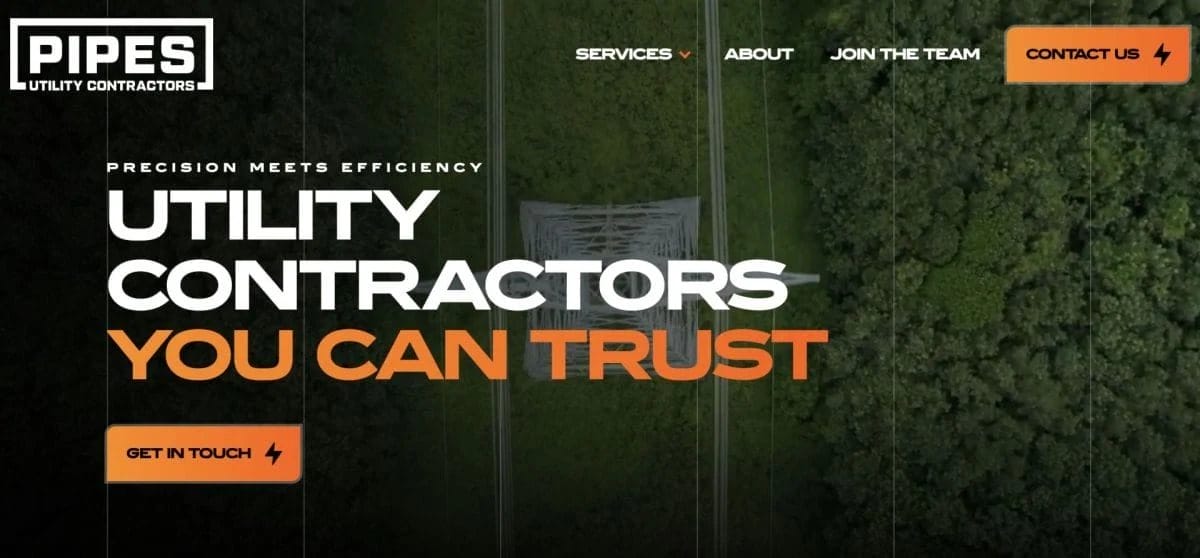
The following example from Pipes Utility Contractors illustrates how best practices translate into real design decisions in construction website design. Sara walked through this page during our interview to show exactly how each principle applies in practice.
[Source: Pipes Utility Contractors]
This page opens with a hero section that puts the value proposition front and center: “Utility Contractor. You can trust.” A background video plays without sound, creating movement without distraction. A sticky “Contact Us” button remains visible at all times as the visitor scrolls.
[Source: Pipes Utility Contractors]
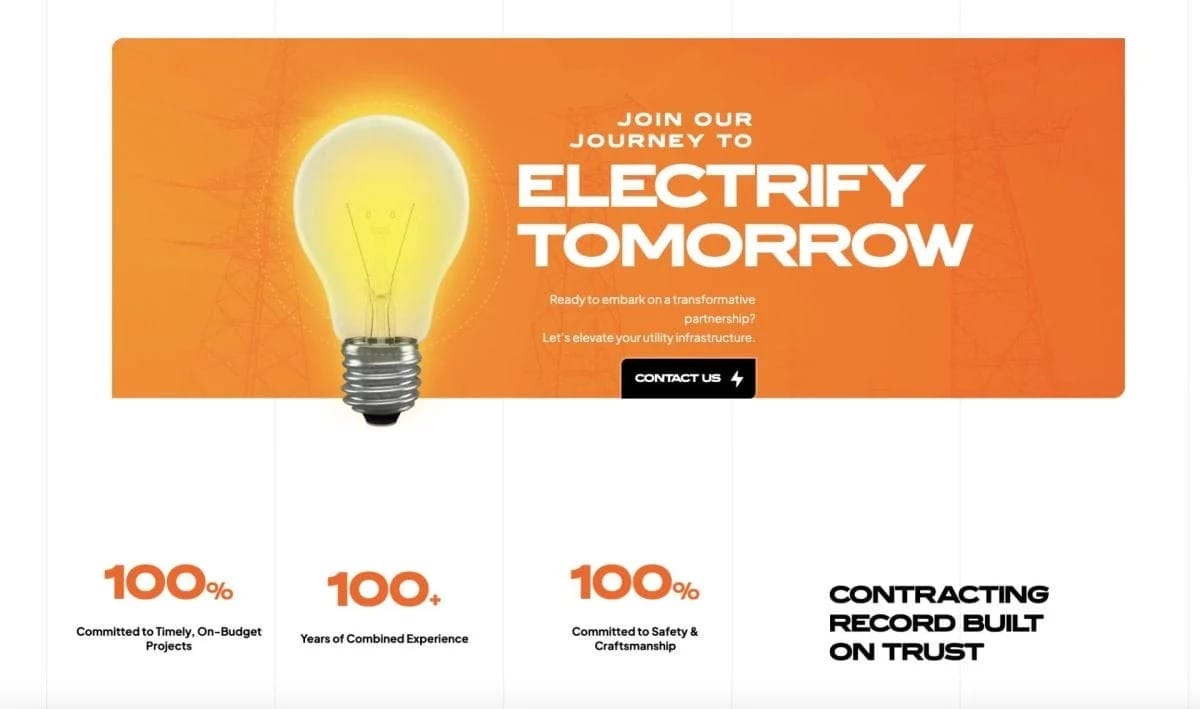
What works:
- UVP visible immediately, no scrolling required
- Background video with no autoplay sound
- Sticky CTA visible throughout the page
- Trust signals (combined years of experience, project numbers) visible before the form
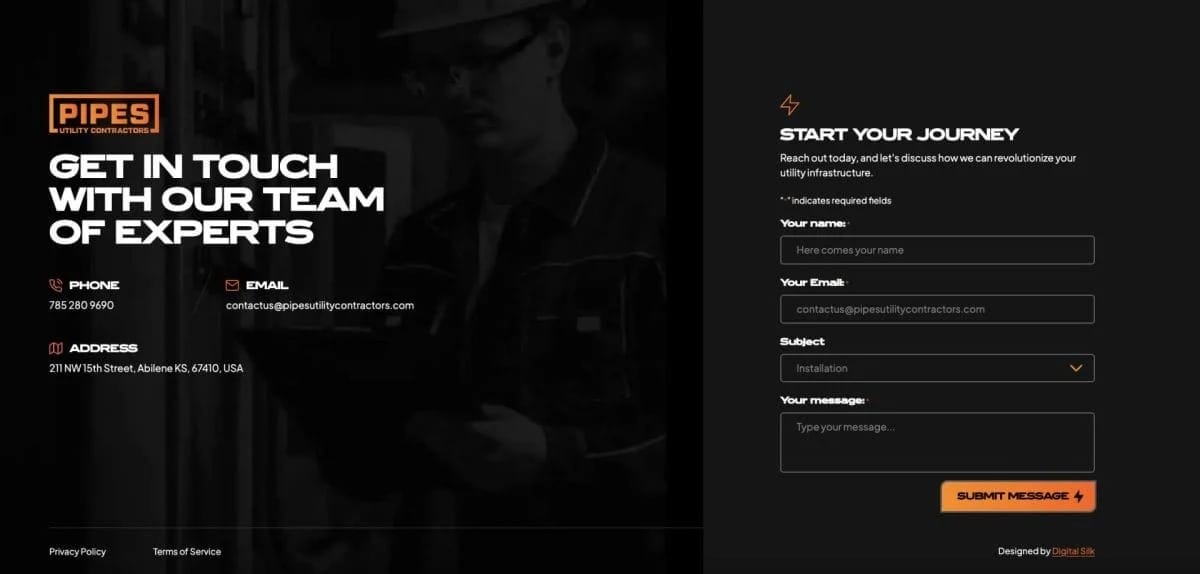
- Form limited to four fields
- Whitespace used to separate sections instead of decorative lines or boxes
[Source: Pipes Utility Contractors]
In Sara’s words: “Everything on the page – the copy, the modules, the structure – is related back to the unique value proposition. That’s what keeps it coherent and keeps the visitor moving forward.”
9. What Are The Most Common Landing Page Mistakes You See?
Forms are a big one. If you have a lot of fields, people either won’t start or they’ll give up halfway through. Three to four fields is completely enough: name, surname, email and a contact number.
The value proposition being buried is another one. You can’t have too much text around it, or hide it under a colorful video where the letters are unreadable. The accent needs to be on the UVP from the moment the visitor lands.
Competing CTAs are also really common. If two buttons are asking for two different things on the same screen, the visitor doesn’t know where to go.
And autoplay video with sound – that’s almost always a mistake. Sometimes it’s just scary. If there needs to be sound, the visitor should be the one to activate it.
Finally, the copy needs to respond to what the audience is asking, not what the company wants to say about itself. When I visit a website, I need to know what’s in it for me. If I don’t know that in the first few seconds, I’m moving on.

10. How Do You Approach Testing And Optimizing Landing Page Design?
Everything we do in landing page design at Digital Silk is built to scale. You start with a minimal viable landing page and then you build on it. You use real data: look at what’s working, what people are clicking, how long they’re staying, and then make decisions based on that.
Google Analytics is your best friend. It tells you which pages are getting traffic and how long people are spending on them. The data gives you the roadmap.
And when it comes to the website itself, longer page time is actually good for SEO. If someone stays on a page for three or four minutes, Google sees that as a signal that the content is relevant and pushes you up in the rankings. So optimization isn’t just about conversion, it’s also about giving people a reason to stay.
[Source: Ruler Analytics Report]
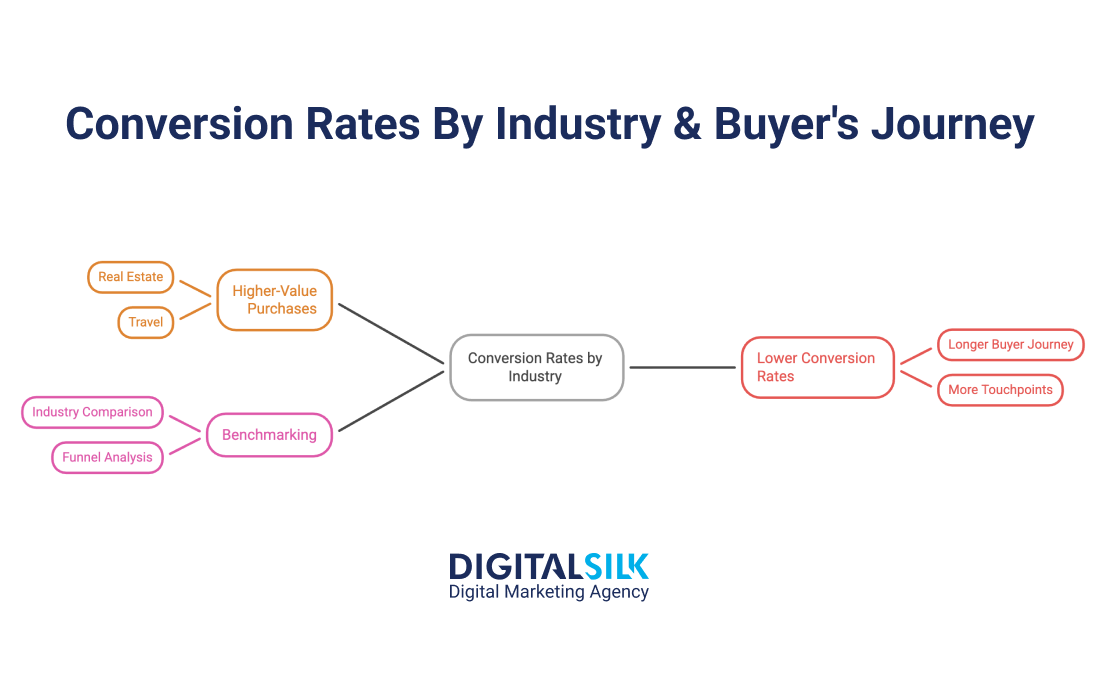
According to Ruler Analytics Report, industries with higher-value or more considered purchases tend to show lower overall conversion rates, not because the marketing is underperforming, but because the buyer’s journey is longer and involves more touchpoints before a conversion is formally captured.
Real estate and travel, for example, sit at 2.8%, but that number reflects a process with significant research and back-and-forth that does not always show up in a single session. This is why benchmarking your landing page against a generic average can be misleading: the right comparison is always within your own industry and funnel.
Key things to test, in priority order:
- Headline and value proposition: the single highest-impact element on any landing page
- CTA copy and color: small wording changes can move conversion rates significantly
- Hero image or video: visual content in the hero directly affects how long visitors stay
- Form length: test removing fields and measure whether completion rates improve
- Social proof placement: try moving testimonials or ratings closer to the CTA
11. What Are The Best Landing Page Design Tools & A Pre-Launch Checklist?
From my experience at Digital Silk, I rely on a core set of tools to ensure landing pages are optimized before launch. The right landing page design tools help teams build, test and optimize pages before launch.
For building, I use platforms like Unbounce, Instapage, Webflow, or Leadpages. For testing and optimization, I work with VWO and Optimizely. Analytics tools like Google Analytics 4, Hotjar, and Microsoft Clarity help me understand user behavior, while Google PageSpeed Insights and GTmetrix ensure performance and speed are solid before going live.
Tools:
- Google Analytics 4 for traffic, session duration and goal completion
- Hotjar or Microsoft Clarity for heatmaps and scroll depth
- VWO for A/B testing
- Unbounce or Instapage for landing page builders with built-in testing
Here is a pre-launch checklist:
| Item | Done? |
| Value proposition is visible above the fold without scrolling | ☐ |
| CTA copy uses an action verb and contrasts visually with the background | ☐ |
| No more than one CTA per screen area | ☐ |
| Form has 3–4 fields maximum | ☐ |
| Social proof is placed near the primary CTA | ☐ |
| Page loads in under 3 seconds (test with PageSpeed Insights) | ☐ |
| Layout is fully functional and conversion-ready on mobile | ☐ |
| Background video (if used) has no autoplay sound | ☐ |
| Page copy addresses the visitor’s needs, not the company’s story | ☐ |
| CTA copy matches the ad or link that drove traffic to the page | ☐ |
| Tracking (GA4, heatmap) is installed and confirmed working | ☐ |
| Form submission triggers a thank-you page or confirmation | ☐ |
| All links and buttons have been tested | ☐ |
| Accessibility: images have alt text, contrast ratios meet standards | ☐ |
| Main site navigation is removed or minimized | ☐ |
Build Landing Pages That Convert With Digital Silk
Strong landing page design is one of the highest-ROI investments in any digital marketing stack. Effective landing page design determines whether the traffic you’re paying for turns into leads, customers and revenue.
Our team designs landing pages from the ground up to perform, combining UX research, conversion-focused design and proven SEO frameworks to drive measurable business results.
As a leading web design agency, our solutions include:
- Custom Web Design
- Digital Marketing
- PPC / paid media landing page services
- SEO strategy
Contact our team, call us today at (800) 206-9413 or fill in the Request a Quote form below to tell us about your project and start your web design journey today.
Tell us about your website goals and let our experts give you a custom proposal
"*" indicates required fields